

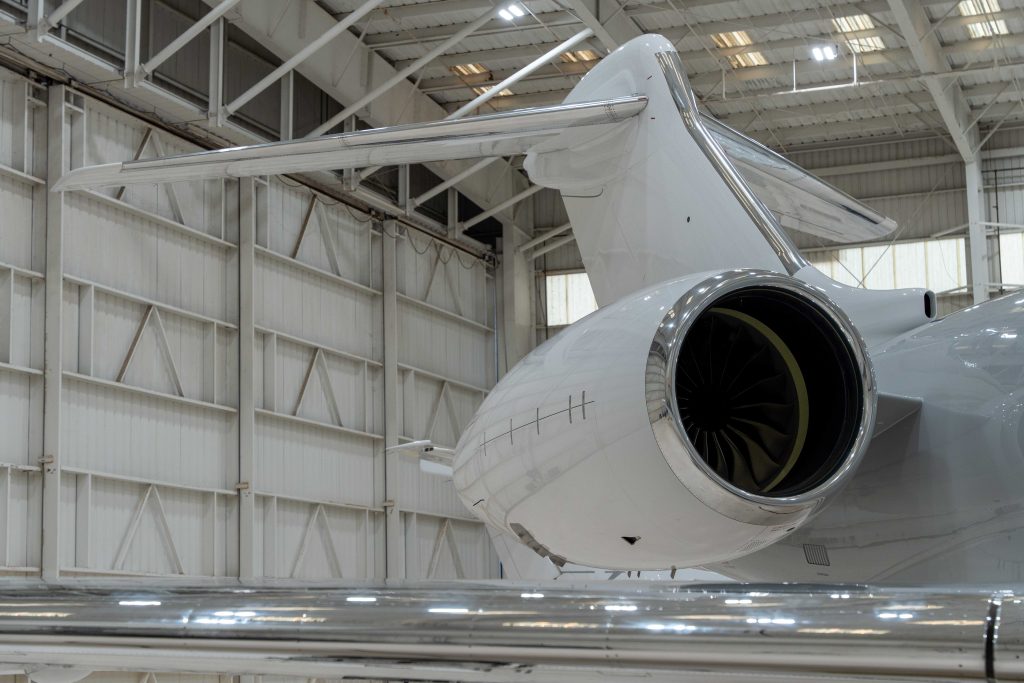
Business Jet Maintenance Programmes Explained
Engine, Airframe & Avionics Coverage, Costs and Value
For anyone purchasing, owning or selling a private jet, one of the most important considerations beyond the aircraft’s purchase price is how its future maintenance exposure will be managed.
Modern business jets can be extraordinarily reliable, but when a major engine, avionics or airframe component does require repair or overhaul, the costs can be substantial. An engine shop visit can run into hundreds of thousands—or on larger aircraft, millions—of dollars. A single avionics display, flight-management computer or other Line Replaceable Unit can cost tens of thousands of dollars to exchange or repair.
For this reason, the business aviation industry has developed a wide range of hourly maintenance programmes, sometimes referred to as power-by-the-hour programmes, that allow an owner to exchange much of this unpredictable maintenance exposure for a predetermined hourly or annual charge.
The principle is relatively straightforward: rather than paying the full cost when a major maintenance event occurs, the owner makes regular payments based primarily on aircraft or engine utilisation. In return, the programme provider assumes responsibility for many of the covered scheduled and unscheduled maintenance costs.
However, not every programme provides the same level of protection, and simply seeing an aircraft advertised as being “on programme” does not necessarily mean that all maintenance exposure has disappeared.
Understanding exactly which programme is installed, the level of coverage, the hourly rate, whether the account is fully paid, and what exclusions remain is essential when assessing both the operating cost and market value of a business jet.
First: Understanding the Programme Names
There is considerable overlap in terminology across the business aviation industry, and several programmes are regularly confused with one another.
For clarity:
- Pratt & Whitney Canada operates the ESP – Eagle Service Plan, including Gold and Platinum coverage levels.
- Williams International operates the TAP – Total Assurance Program family, including TAP Blue and other legacy or aircraft-specific TAP variants.
- Honeywell operates the MSP – Maintenance Service Plan, including MSP Gold for engines and APUs.
- Textron Aviation operates PowerAdvantage / PowerAdvantage+ on qualifying Citation aircraft engines and jointly offers TapAdvantage Blue with Williams International for FJ44-powered aircraft.
- Cessna/Textron ProParts covers airframe and avionics parts.
- Embraer Executive Care – EEC provides airframe maintenance coverage for Embraer Executive Jets.
- What many operators still call Honeywell HAPP – Honeywell Avionics Protection Plan has increasingly been incorporated into Honeywell’s broader MSP Avionics product family. Honeywell describes MSP today as encompassing propulsion, avionics, nacelles and control systems.
This distinction becomes particularly important during an aircraft purchase because two aircraft described simply as “fully programmed” can have materially different levels of financial protection.
ENGINE MAINTENANCE PROGRAMMES
Pratt & Whitney Canada ESP – Eagle Service Plan
Pratt & Whitney Canada’s ESP programme is one of the most widely recognised OEM engine maintenance programmes in business aviation.
The programme operates on a pay-per-hour basis and is intended to convert major scheduled and unscheduled engine expenditure into a predictable operating cost.
Pratt & Whitney currently states that ESP has no annual flying minimum and is transferable when the aircraft is sold, although the exact coverage available varies according to engine and aircraft model.
Standard ESP Coverage
Pratt & Whitney’s current coverage structure includes items such as:
- Engine overhaul or refurbishment
- Hot Section Inspections
- Basic Unplanned Engine Removal repairs
- Basic Unplanned Accessory Removal
- Troubleshooting labour
- Service Bulletin incorporation
- Lease-engine support
- Engine trend monitoring
- Oil analysis
Higher coverage levels add further protection.
ESP Gold
ESP Gold typically increases the programme’s protection to include areas such as:
- Engine removal and installation
- Mobile Repair Team support during AOG events
- Freight
- Life-limited component replacement
ESP Platinum
Platinum sits at the upper end of Pratt & Whitney’s published ESP coverage and can additionally include:
- Routine periodic inspections
- Environmental damage repair
- Additional engine-model-specific services
Pratt & Whitney’s published programme comparison confirms that the precise entitlement depends upon aircraft and engine model.
What about ESP Gold Lite?
Owners and brokers will occasionally see ESP Gold Lite referenced on individual aircraft.
It is important to understand that Gold Lite is not currently presented as one of the main universal coverage levels on Pratt & Whitney’s public ESP comparison page. It nevertheless exists on certain individual or legacy contracts.
For example, a Phenom 100E currently advertised in the market lists ESP Gold Lite at $217.50 per engine per flight hour based on its 2024 contract rate.
Consequently, when buying an aircraft advertised as “ESP Gold Lite”, the actual contract should be reviewed rather than assuming it provides the same protection as ESP Gold.
Indicative ESP Costs
There is no single ESP price applicable across the entire business jet fleet.
Rate depends upon:
- Engine model
- Engine age and hours
- Coverage level
- Aircraft utilisation
- Existing programme balance
- Entry point into the programme
- Region
- Contract escalation
Real-world aircraft listings nevertheless provide useful examples.
A Phenom 300 equipped with PW535E engines has been advertised with an ESP Gold rate of $222.65 per engine/hour, while a Phenom 300E example lists $281.50 per engine/hour.
That places the combined engine-programme payment for those examples at approximately $445-$563 per aircraft flight hour for the pair of engines.
These figures should be regarded as examples, not current universal Pratt & Whitney quotations.
Williams International TAP
Williams International’s FJ33 and FJ44 engines power a significant portion of the light business jet market.
The associated maintenance programmes are generally known under the TAP – Total Assurance Program family.
Operators may encounter names including:
- TAP
- TAP Elite
- TAP Advantage
- TAP Advantage Elite
- TAP Blue
- TapAdvantage Blue
The terminology varies considerably according to aircraft, contract vintage and whether the programme is being administered directly or through an OEM relationship.
For Citation aircraft, Textron Aviation currently promotes TapAdvantage Blue, which it developed in conjunction with Williams International for FJ44 operators.
What Does TAP Blue Cover?
Textron’s current TapAdvantage Blue description includes extensive protection for both scheduled and unscheduled maintenance.
Scheduled Major Periodic Inspection coverage can include:
- Inspection and assembly shop labour
- Oil-filter analysis
- Wear items
- Component repairs
- Removal and installation labour
- Life-cycle-limited components
Unscheduled coverage includes:
- Shop labour
- Consumables
- Wear items
- Engine or module exchange
- Replacement parts
- Troubleshooting
- Rental-engine support
Routine periodic inspections and mandatory, recommended and optional Service Bulletins can also receive parts and labour coverage.
That breadth of coverage is one of the reasons TAP Blue status is particularly relevant to aircraft such as the Citation M2, CJ series and other FJ44-powered business jets.
Indicative TAP Blue Costs
Again, rates are contract specific.
A currently marketed Citation M2 shows a TapAdvantage Blue rate of $239.79 per engine/hour, equivalent to approximately $480 per aircraft flight hour for both engines. Its associated ProParts programme is separately listed at $256.46 per flight hour.
A 2024 Citation CJ4 Gen2 currently marketed with a 2026 programme rate shows:
- $290.41 per engine/hour in North America
- $317.29 per engine/hour outside North America
That equates to approximately $581-$635 per flight hour for the engine pair.
For budgeting purposes, therefore, an owner of a modern Williams-powered Citation might reasonably encounter an engine-programme commitment in the region of $480-$650+ per aircraft flight hour, depending heavily upon model and agreement.
Honeywell MSP – Maintenance Service Plan
Honeywell’s Maintenance Service Plan – MSP is another major component of the business aviation maintenance-programme market.
It is particularly relevant to aircraft powered by Honeywell’s TFE731 and HTF engine families.
Honeywell has progressively expanded MSP beyond engine protection into an umbrella covering:
- MSP Propulsion
- MSP APU
- MSP Nacelle
- MSP Avionics
- MSP Control Systems
Honeywell also now incorporates connected engine-health monitoring and usage-based pricing into parts of the programme. Qualifying operators can receive credits of up to 10% based on operating parameters.
MSP and MSP Gold
Honeywell’s engine and APU literature shows coverage for major events including:
- MPI, CZI and HSI events
- Inspection labour
- Consumable and replacement parts
- Component repairs
- Life-limited parts
- Unscheduled repairs
- Rental engines
- Engine or LRU exchange
- Service Bulletins
- FOD gap protection
Gold coverage can extend items such as removal and installation, freight, AOG logistical support and higher troubleshooting allowances depending upon the applicable contract.
Indicative Honeywell MSP Gold Costs
Honeywell-powered super-midsize business jets illustrate the scale of the programme.
A Challenger 300 has been advertised with Honeywell HTF7000 engines on MSP Gold at approximately $467.51 per engine/hour.
A Challenger 350 example lists its HTF7350 engines at $580.13 per engine/hour, with its Honeywell APU separately enrolled at $163.13 per APU hour.
Another Challenger 350 example shows $538.91 per engine/hour.
Consequently, an MSP Gold commitment on a modern super-midsize aircraft can easily exceed $1,000 per aircraft flight hour for the two engines alone.
The number may appear substantial until compared with the potential cost of an uncovered major HTF engine event.
Textron Aviation PowerAdvantage
PowerAdvantage deserves separate mention because it is frequently confused with Williams International’s own programmes.
PowerAdvantage is a Textron Aviation programme, rather than the name of Williams International’s standard programme.
Textron currently offers PowerAdvantage products for qualifying Citation aircraft using Pratt & Whitney Canada and Honeywell engines.
Coverage can include:
- Engine reserves through overhaul
- HSI and overhaul parts
- Scheduled and unscheduled engine maintenance
- Line Replaceable Units
- Consumables
- Service Bulletins
- Rental engines
PowerAdvantage+ provides additional coverage depending upon the engine family, including additional shop labour and other costs.
A Citation Latitude market example lists its PW306D1 engines on PowerAdvantage at $680 per engine/hour, or approximately $1,360 per aircraft flight hour for both engines.
This highlights how significantly engine reserves increase as aircraft move from the light-jet category into midsize and larger business jets.
AIRFRAME AND AVIONICS MAINTENANCE PROGRAMMES
Engine programmes receive much of the attention during an aircraft sale, but an aircraft can still generate substantial expenditure away from its engines.
Landing gear components, actuators, valves, brakes, wheels, avionics, cabin systems, electrical components and other airframe parts can all generate significant unscheduled costs.
Airframe and avionics programmes therefore form an increasingly important part of a fully programmed aircraft.
Honeywell HAPP – Now MSP Avionics
The Honeywell Avionics Protection Plan, traditionally known as HAPP, remains a very familiar name within business aviation.
Honeywell has subsequently brought HAPP into the broader MSP structure, and its current terminology increasingly uses MSP Avionics.
Honeywell describes MSP Avionics as the successor to HAPP and provides protection for flight-deck components, safety systems and other eligible avionics.
Coverage can include:
- Repair and exchange services
- Loaner units
- AOG support
- Factory-backed support
- Freight subject to programme terms
- Access to Honeywell’s global support network
- Transferable agreements
- Selected third-party components under certain packages
HAPP/MSP Avionics Pricing
Unlike many engine programmes, avionics programmes have historically often been priced through an annual aircraft fee rather than simply a flight-hour charge.
This makes quoting one universal “$ per hour” figure misleading.
For example, a previously published Citation Sovereign case showed a HAPP annual cost of approximately $75,300. That example is historical rather than a current Honeywell quotation, but it demonstrates the economics involved.
At 300 flight hours per year, a $75,300 annual programme would equate economically to approximately $251 per flight hour.
At only 150 hours per year, however, the effective cost becomes approximately $502 per flight hour.
This demonstrates why annual aircraft utilisation is critical when evaluating avionics protection.
Cessna ProParts
Textron Aviation’s ProParts programme provides airframe and avionics parts protection for qualifying Citation aircraft.
Textron states that ProParts covers parts and consumables required for:
- Line maintenance
- Scheduled maintenance
- Unscheduled maintenance
- Normal wear
- Exchange, repaired and new parts
- Mandatory Service Bulletins
Examples of eligible components include wheels, tyres, avionics, brakes, valves, actuators, gauges, instruments and various cabin-related hardware.
Importantly, ProParts should not automatically be interpreted as complete airframe maintenance coverage including labour.
Textron separately offers ProTech, which covers scheduled and unscheduled maintenance labour.
This is an important distinction when analysing a Citation advertised as being “on ProParts”.
Indicative ProParts Costs
Published aircraft examples demonstrate how rates increase with aircraft size.
A Citation M2 is currently advertised at approximately:
$256.46 per flight hour – ProParts.
A Citation CJ3 example shows:
$309 per flight hour – ProParts.
A Citation Latitude example shows:
$596 per flight hour – parts programme, alongside separate PowerAdvantage, ProTech and APU programme charges.
A reasonable planning range for Citation ProParts can therefore move from roughly $250-$400 per hour on some light jets towards $600 or more on larger Citation platforms, although an individual Textron quotation should always take precedence.
Embraer Executive Care – EEC
Embraer’s equivalent airframe-support product is Executive Care, commonly abbreviated to EEC.
Embraer describes Executive Care as a comprehensive airframe maintenance programme available across its Executive Jet platforms.
Current coverage levels include:
- Prime Parts
- Standard
- Enhanced
Depending upon the selected programme, coverage can extend across airframe systems, avionics, interior components and maintenance events, together with access to Embraer’s Mobile Recovery Team for qualifying AOG situations.
Payments are based partly on reported flight hours, and Embraer states that Executive Care itself does not require minimum flight hours.
Indicative EEC Costs
A Phenom 100E market example lists:
- EEC Standard: $345.33 per flight hour
- $1,519.44 monthly fee
The same aircraft shows its two engines separately enrolled on ESP Gold Lite.
A Phenom 300E example lists EEC Enhanced at approximately:
- $320.04 per airframe flight hour
- $3,244.21 monthly airframe charge
Its PW535 engines are separately shown on ESP Gold.
Moving into the midsize category, a Legacy 450 example lists Executive Care Enhanced at:
- $990.29 per flight hour
- $11,394.11 per month
with scheduled and unscheduled maintenance, labour, expendable parts and mobile recovery described within the programme.
Again, these examples demonstrate that there is no meaningful single EEC rate applicable to every Embraer.
APU PROGRAMMES SHOULD NOT BE FORGOTTEN
The Auxiliary Power Unit is another major maintenance asset frequently overlooked when discussing “fully programmed” aircraft.
Honeywell offers MSP coverage for qualifying APUs, while Textron offers AuxAdvantage on relevant aircraft.
Textron describes AuxAdvantage as an hourly programme covering scheduled and unscheduled APU parts, overhaul requirements and rental APU support.
Actual market examples include approximately:
- $50 per APU hour on one Citation Latitude AuxAdvantage contract.
- $130-$163 per APU hour on Honeywell MSP-equipped Challenger 300/350 examples.
On larger aircraft, APU programme status should therefore form part of the same pre-purchase review as the main engines.
THE ADVANTAGES OF MAINTENANCE PROGRAMMES
1. Predictable Operating Costs
The principal attraction is financial predictability.
Rather than receiving a potentially enormous invoice when an engine reaches overhaul or suffers an unscheduled event, the owner has progressively funded the maintenance exposure through hourly payments.
For corporate flight departments, family offices and aircraft-management companies, this makes annual budgeting considerably easier.
2. Protection Against Major Unscheduled Events
A well-structured comprehensive programme effectively transfers much of the financial risk associated with a major component failure to the programme provider.
That protection becomes increasingly valuable as aircraft size and component cost increase.
3. Improved Resale Marketability
Programme status can materially influence how buyers perceive an aircraft.
A buyer comparing two otherwise similar aircraft may place a significant premium on the aircraft whose engines are fully enrolled and financially current because the future engine exposure is easier to quantify.
Pratt & Whitney, Honeywell, Textron and Embraer all specifically reference residual or resale value among the benefits of their respective maintenance programmes.
4. Easier Aircraft Transactions
Maintenance programmes can reduce uncertainty during a pre-purchase inspection.
An unexpected engine discrepancy on a fully funded programme may represent an inconvenience and scheduling issue rather than a six-figure negotiation between Purchaser and Seller.
5. AOG and Rental Support
Premium programmes increasingly include rental engines, logistical support, Mobile Repair Teams, freight or AOG support.
The value is therefore not limited simply to paying the eventual repair invoice.
Getting an aircraft back into service quickly can be equally important.
6. Protection Against Maintenance Inflation
Many agreements establish defined mechanisms for annual rate increases.
Although this does not eliminate inflation, it creates a more transparent relationship between utilisation and future maintenance cost.
THE DISADVANTAGES
Maintenance programmes are not automatically the financially superior solution for every aircraft.
1. The Owner May Pay More Over Time
If an aircraft experiences very few unscheduled problems, an owner who has paid hundreds of thousands of dollars into programmes may ultimately have spent more than an equivalent self-funded operator.
The programme provider is assuming financial risk and naturally prices the agreement accordingly.
2. Hourly Rates Can Become Significant
Consider a private jet paying:
- $550/hour for two engines
- $350/hour for an airframe programme
- $150/hour effective avionics reserve
- $100/hour for APU protection
The owner could easily be spending more than $1,000 per flight hour on maintenance programmes alone, before fuel, crew, routine maintenance, landing fees or any other operating cost.
On midsize and super-midsize jets the combined programme burden can be substantially higher.
3. Rate Escalation
Programme rates rarely remain static throughout the aircraft’s life.
Textron, for example, specifically states that ProParts rates are adjusted by CPI-W, while PowerAdvantage agreements can adjust according to labour and OEM parts pricing. Honeywell similarly refers to rate adjustments tied to economic indices.
Owners should therefore evaluate the likely programme cost over the expected ownership period rather than concentrating solely on today’s hourly rate.
4. Catch-Up or Buy-In Costs
Placing an older aircraft onto programme can require a substantial catch-up contribution.
The provider must recognise that the aircraft may be much closer to a major maintenance event than an aircraft enrolled from new.
Consequently, an apparently attractive aircraft that is currently “off programme” cannot necessarily be placed onto full coverage simply by commencing the normal hourly payment.
5. Not Everything Is Covered
This is perhaps the biggest misconception.
Depending upon the agreement, exclusions may still include:
- Certain corrosion
- Environmental damage
- Foreign Object Damage
- Cosmetic deterioration
- Upgrades and modifications
- Some troubleshooting labour
- Shipping, customs or duties
- Fluids
- Insurance-related damage
- Operator-induced damage
- Components beyond stated economic repair criteria
Honeywell, for example, specifically notes that fluids such as oil and fuel are not covered under the engine/APU MSP provisions described in its programme literature.
The contract—not the programme name—is therefore what ultimately determines the value.
MAINTENANCE PROGRAMMES AND AIRCRAFT VALUE
From an aircraft sales perspective, maintenance programme status can become almost as important as aircraft age and total time.
Consider two identical aircraft.
Aircraft A has 3,000 hours, fully funded engines and comprehensive airframe coverage.
Aircraft B has 3,000 hours but has been privately self-funded since new.
Aircraft B may have impeccable maintenance history and technically be just as good an aircraft.
However, the buyer of Aircraft B is inheriting considerably greater exposure to the next engine event.
That difference frequently becomes reflected in negotiations.
The important questions are therefore not simply:
“Are the engines on programme?”
but rather:
- Which programme?
- Which coverage level?
- What is the current hourly rate?
- Is the account fully paid?
- Are there any deferred programme hours?
- Is a catch-up payment outstanding?
- Is the agreement transferable?
- Is there a transfer charge?
- Are there minimum annual hours?
- Is FOD covered?
- Is corrosion covered?
- Are LLPs covered?
- Are engine removal and installation included?
- Is freight included?
- Is rental-engine support included?
- What happens to the programme balance at sale?
These questions should form part of the technical and commercial due diligence on any pre-owned business jet.
Indicative Maintenance Programme Cost Comparison
| Programme | Area | Example Market Cost |
|---|---|---|
| Pratt & Whitney ESP Gold / Gold Lite | Engine | Approx. $220-$280+ per engine/hr on Phenom examples |
| Williams TAP / TapAdvantage Blue | Engine | Approx. $240-$317 per engine/hr on M2/CJ4 examples |
| Honeywell MSP Gold | Engine | Approx. $470-$580 per engine/hr on Challenger 300/350 examples |
| Textron PowerAdvantage | Engine | Approx. $680 per engine/hr on one Latitude example |
| Cessna ProParts | Airframe Parts | Approx. $250-$600+ per aircraft/hr depending model |
| Embraer Executive Care | Airframe | Approx. $320-$1,000+ per aircraft/hr, often plus monthly charge |
| Honeywell MSP Avionics / HAPP | Avionics | Commonly annual/fixed-price structure rather than a universal hourly rate |
| Honeywell MSP / AuxAdvantage | APU | Approx. $50-$160+ per APU/hr in referenced examples |
Important: These figures are indicative examples taken from aircraft currently or recently marketed with disclosed programme rates. They are not OEM quotations. Rates can vary materially according to aircraft, engine, region, utilisation, agreement date, programme level and enrolment status.
Programme or Self-Fund?
Ultimately, there is no universal answer.
For a low-value, mature aircraft flown relatively few hours each year, an experienced operator with sufficient financial reserves may conclude that self-funding maintenance represents the better economic decision.
At the opposite end of the market, operating a newer midsize, super-midsize or large-cabin aircraft without engine coverage can expose the owner to exceptionally large and unpredictable maintenance bills.
There is also a commercial consideration.
An owner may be entirely comfortable carrying the maintenance risk personally, but the eventual purchaser of the aircraft may not be.
The true value of a maintenance programme is therefore a combination of:
maintenance protection + cash-flow predictability + aircraft availability + resale liquidity.
Overall Review
Engine, airframe and avionics maintenance programmes have become an integral part of modern business jet ownership.
Pratt & Whitney ESP, Williams TAP, Honeywell MSP, Textron PowerAdvantage and ProParts, Honeywell MSP Avionics/HAPP and Embraer Executive Care all ultimately seek to achieve the same fundamental objective: turn unpredictable maintenance exposure into a more predictable cost of aircraft ownership.
The advantages can be considerable. Major maintenance expenses can be controlled, unscheduled failures become financially manageable, AOG recovery can be faster, and programme enrolment can materially improve an aircraft’s attractiveness when it comes time to sell.
The disadvantage is equally clear: this protection comes at a cost.
On a fully programmed business jet, engine, airframe, avionics and APU programmes combined can represent one of the largest components of the aircraft’s hourly operating budget.
The correct question is therefore not simply whether an aircraft is “on programme”.
The more important question is:
What exactly does the programme cover—and what financial exposure remains with the owner?
For both purchasers and sellers, understanding that distinction is essential when establishing the true operating cost and market value of a private jet.
Aviator Aircraft Sales supports private aircraft owners and buyers throughout the acquisition, sale and technical evaluation process. Our experience across international business aviation transactions allows us to assess not only the aircraft itself, but also the equipment, operating profile and future investment required to ensure it is suitable for its next owner.
For further information or to discuss the acquisition or sale of a private aircraft, contact Aviator Aircraft Sales.
Aviator Aircraft Sales
London, United Kingdom
www.aviatoraircraftsales.com