

Buyers Guide To The Embraer Phenom 100
This guide covers a Buyer’s Guide to Purchasing a Embraer Phenom 100 Aircraft.
In July 2007, the Phenom 100 took to the skies for its initial flight before being delivered in December of the following year. This model was specifically tailored for individual owner-operators and became renowned as a top choice for introductory-level jets. In fact, it was utilized by multiple airline training departments and even served as an aircraft for RAF student training.
The Phenom 300 came after its predecessor, the Phenom 100.
Make sure to acquaint yourself with the specifications of the Phenom 100 before making a purchase.
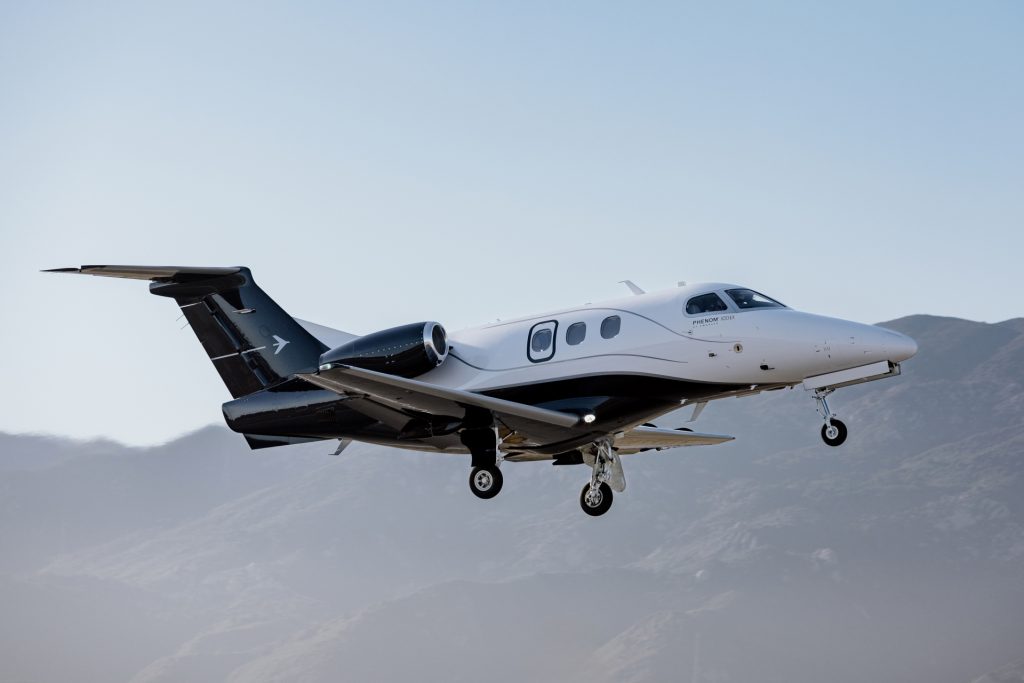
The Phenom 100 executive jet has a height of 14ft 3in and measures 42ft 1in in length. Its wingspan spans 40ft and 4in, with a tail length of 17ft and 6in. Its standard basic operating weight is at 7,220lb.
The pair of Pratt & Whitney PW617F1-E engines generate 1,730 lbf of thrust apiece, a 15% increase from Embraer’s prior versions. This results in faster takeoffs and reduces the time it takes to reach cruising altitude by 25%.
At its peak operating altitude of 41,000ft, this aircraft has the capability to travel at a high speed cruise of 405 kts and cover a distance of 1,178 nautical miles (based on four occupants).
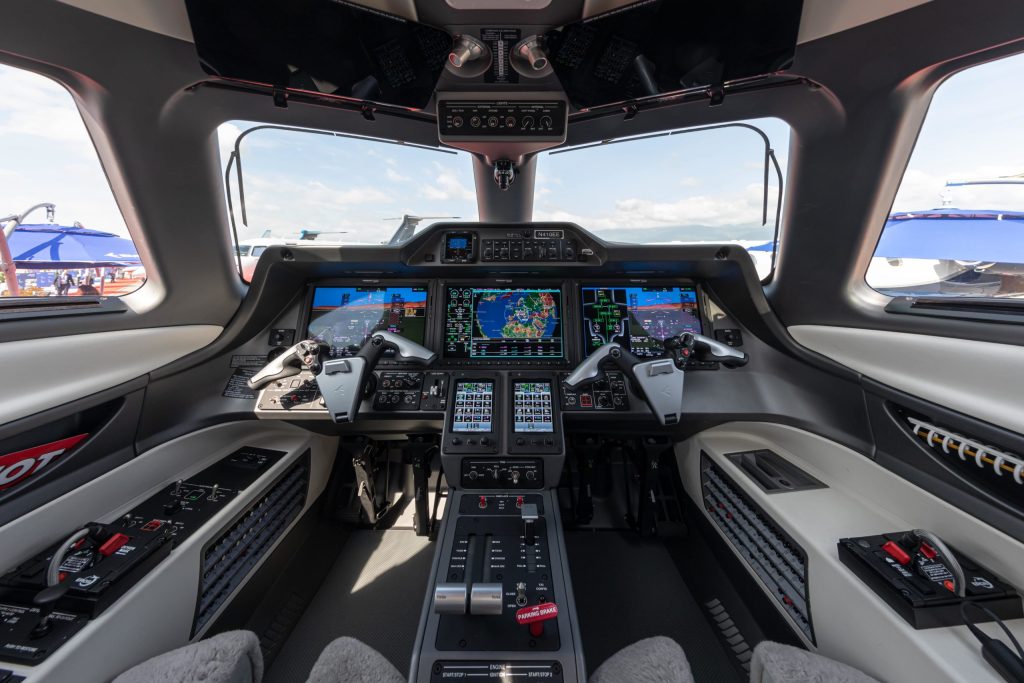
The Phenom 100 is equipped with intuitive avionics and smart automation, allowing for single pilot operation and reduced checklists.
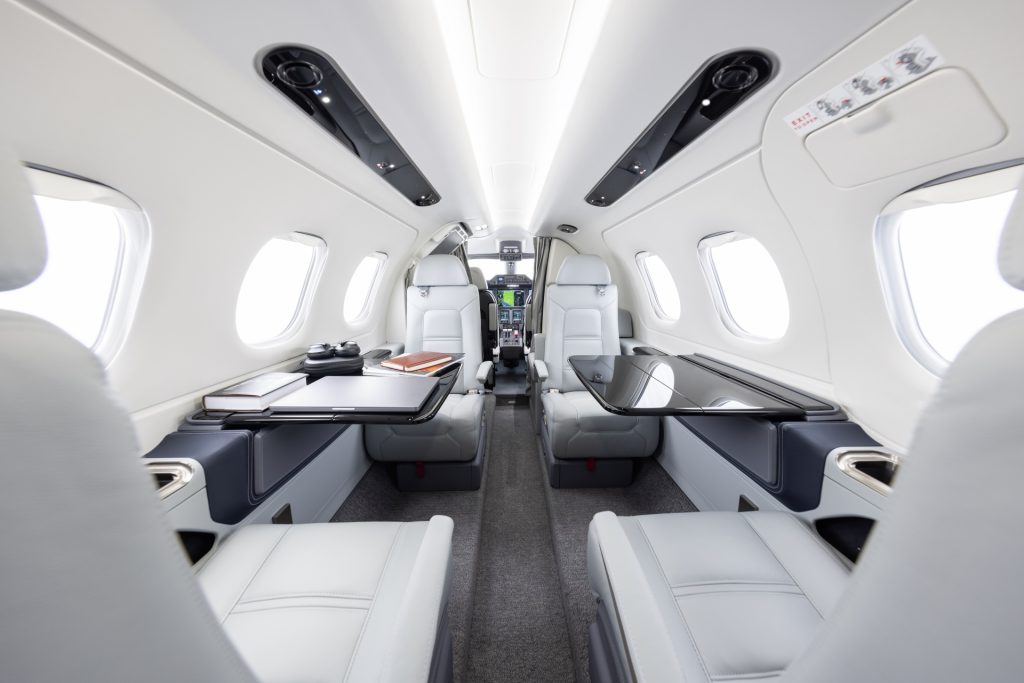
The 11ft long Oval Lite Cabin, crafted by BMW DesignworksUSA, stands at a height of 4ft 9in and spans a width of 5ft 1in. With a spacious volume of 212 cubic feet, the cabin boasts generous windows that flood the interior with natural light. Notably, even the private lavatory features windows, making this category the only one to offer such a feature.
The typical arrangement for seating allows four individuals to comfortably sit, but can accommodate a maximum of seven passengers and one crew member.
The cockpit includes the Prodigy Touch Flight Deck, which features three 14.1in interchangeable displays, standard Flight Management and Synthetic Vision Systems, and a weather radar with vertical scan, ground clutter suppression, and turbulence detection capabilities.
If you are considering purchase a small jet either for personal or business use – Then please contact us today where we can guide you through the current aircraft marketplace as well as discuss aircraft costs and values. Contact Us
Interested in the Cessna CJ4? View our CJ4 business jet guide HERE
Embraer Phenom 100 Specifications
| Specification | Detail |
|---|---|
| Length | 42.1 ft (12.83 m) |
| Wingspan | 40.4 ft (12.30 m) |
| Height | 14.3 ft (4.35 m) |
| Cabin Length | 11.0 ft (3.35 m) |
| Cabin Width | 5.1 ft (1.55 m) |
| Cabin Height | 4.9 ft (1.50 m) |
| Max Take-Off Weight (MTOW) | 10,472 lb (4,750 kg) |
| Max Range | 1,178 nm (2,182 km) |
| Max Cruise Speed | 390 ktas |
| Max Altitude (Ceiling) | 41,000 ft |
| Engines | 2x Pratt & Whitney Canada PW617F1-E turbofan |
| Typical Passenger Capacity | 4–7 |
| Baggage Volume | 60 cu ft (1.70 m³) including external nose compartment |
Phenom 100 Ownership Costs
The Phenom 100 sits at the entry-level of the very light jet (VLJ) category and its economics reflect that positioning. It is one of the more affordable jets to own and operate in the pressurised turbofan category.
Annual fixed costs for a single-pilot owner-operated aircraft are typically £150,000–£220,000, covering pilot salary or contractor fees, hull insurance, hangarage, and airframe subscriptions. The aircraft can be flown single-pilot under EASA and FAA regulations, which is the norm for private owner operations and reduces crew costs substantially.
Variable costs per flight hour run from approximately £700 to £1,000. The PW617F1-E engines are relatively simple turbofans with combined fuel consumption around 80–100 US gallons per hour at cruise. Engine overhaul costs on the PW617 family are lower than those on larger turbofans, typically £100,000–£180,000 per engine at TBO. The ESP programme is available and recommended for operators who fly more than 200 hours annually.
Scheduled maintenance on the Phenom 100 is straightforward and well-documented. Embraer’s phased inspection programme keeps aircraft available and the global Embraer service network supports the type. Annual inspection costs for a standard airframe are in the range of £20,000–£40,000, making the Phenom 100 genuinely competitive with piston twins and turboprops on a maintenance cost basis.
Phenom 100 Market Position and Resale Value
The Phenom 100 competes in the very light jet segment alongside the Cessna Citation Mustang and the HondaJet. Of these three, the Phenom 100 offers the widest cabin cross-section — a genuine differentiator at this price and weight level.
Pre-owned Phenom 100 values range from approximately £1.2 million to £2.8 million depending on year, variant (EV vs standard), total hours, and avionics status. Annual depreciation averages 5–8%, though the Phenom 100EV commands a modest premium over older examples due to its newer avionics and cabin improvements. Market liquidity is good, reflecting the large installed fleet and broad buyer appeal across owner-operators and flight training organisations.
Phenom 100 Variants and History
The Phenom 100 was announced alongside the Phenom 300 at NBAA 2006 and made its first flight on 26 July 2007. ANAC certification was achieved in December 2008, followed by FAA approval in January 2009. First deliveries occurred in early 2009.
The original Phenom 100 used the Garmin G1000 avionics suite (branded as Prodigy) and established the type as the benchmark VLJ in terms of cabin quality and build standards. The PW617F1-E engines are derated versions of the PW610 family and proved reliable in service.
The Phenom 100E was introduced in 2013 with cabin improvements, enhanced soundproofing, and revised seating. The Phenom 100EV — the current production standard, introduced in 2017 — is the most significant update, bringing the Garmin G3000 avionics suite (touchscreen, equivalent to the Phenom 300’s system), a revised interior, improved air conditioning, and minor performance enhancements. The EV designation stands for Enhanced Value, and the improvements are material enough that buyers distinguishing between EV and earlier variants are making a meaningful choice.
Total Phenom 100 deliveries across all variants exceeded 350 aircraft. Production continues at Embraer’s Gavião Peixoto facility alongside the Phenom 300.